
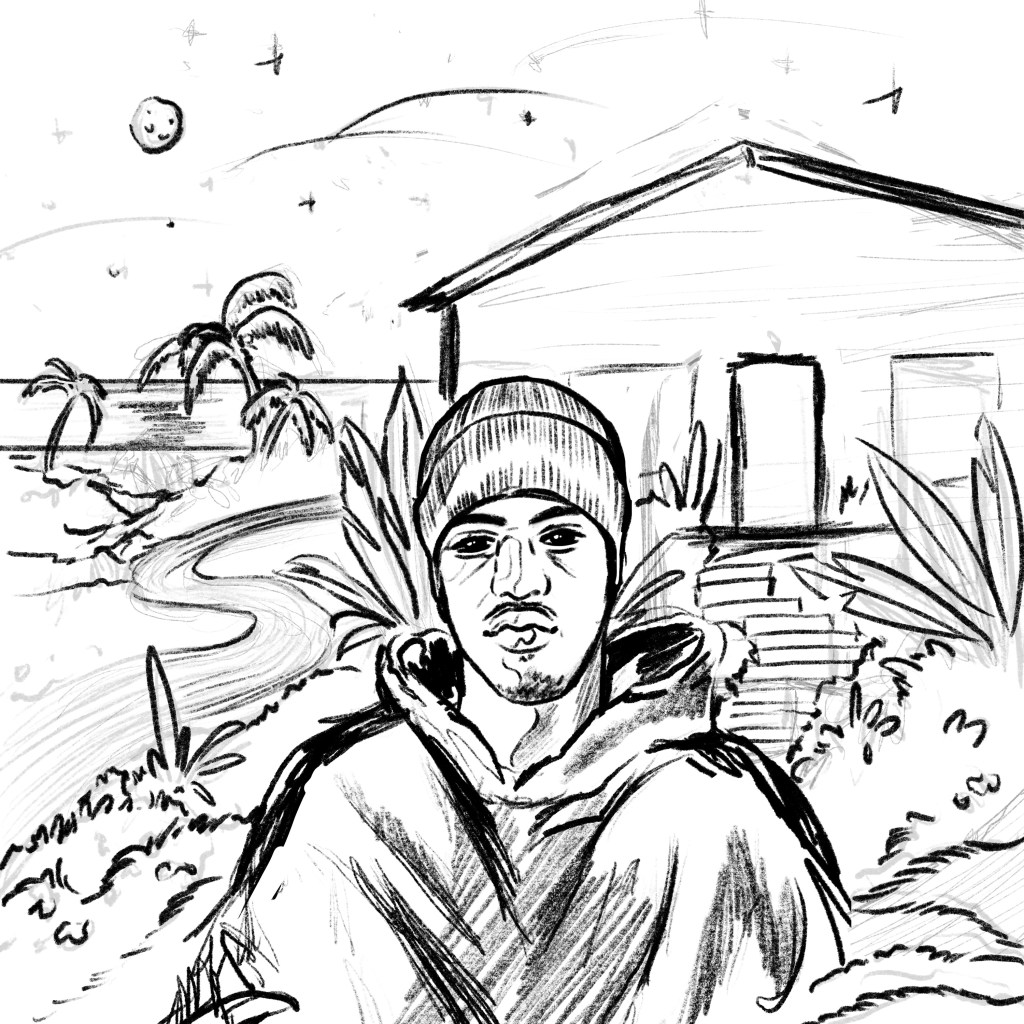
APRIL 2024 || Rapper/ producer insyt’s debut album Mi Casa, Su Casa is an invitation into his wildly colorful, insightful, and deeply personal world. Nevertheless, his journey in creating it was far from straightforward.
It may be that the most important characteristic of a great artist is courage. Rick Rubin once wrote that “creativity is a fundamental aspect of being human…it’s for all of us.” But, while we all may be endowed with the ability to create, only few of us have the rare ability—the courage—to share the deeply personal. Courageous artists subvert the comfort of privacy in the service of creating great art that resonates on a fundamentally human level. Only this kind of art forces us, as spectators, to look inward. And, thus, it’s this courageously authentic kind of art that serves a greater purpose.
Fortunately, rising rapper/producer insyt is courageous. His self proclaimed guiding principle: “what’s mine is yours.”
Beyond the sophisticated, soulful production, insyt’s debut album Mi Casa, Su Casa is exactly as stated—an invitation into the artist’s wildly colorful, insightful, and deeply personal world. In it, he weaves together strings of honest self-assessment, reflections on his own shortcomings, and, ultimately, invites the listener on the deeply intimate story of his personal growth over the last year.
Nevertheless, considering the multiple EPs, tens of thousands of listeners on Spotify and Soundcloud, and half a decade’s worth of music experience under his belt, insyt’s journey in creating Mi Casa, Su Casa was far from straightforward. In making this debut album, insyt endured some of the most difficult moments of his life thus far.
“I feel the need to be honest about this stuff” insyt says. “Sharing it points me in the direction of being able to let it all go. Releasing the record and releasing the story helps me move on from the events that inform the music.”
“How to Draw a Circle” Directed by Genesis Dacayanan
Around this time last year, insyt was holding onto a completely different, original version of his debut album. After having planned to release the project last summer, a painful convergence of events including an ongoing battle against depression, the end of a years-long relationship, and the loss of a hard-drive storing the original project, forced insyt to reconsider the entire endeavour.
“It was an entirely different project,” insyt reflected on the original album. “It was a little more upbeat…I wasn’t digging in as much.” While the project may have been rose-colored, the artist had been struggling for months in a battle against depression that caused him to completely recede from life. He remembers this time in the early months of last year as some of the most difficult moments he’s endured. “It was dark. Like being stuck in a hole. Being in a place where people are trying to give you ladders to get out and you’re just like ‘no.’”
Around this time, the artist began dealing with the end of a years-long relationship—a circumstance that he recounts made him spiral even deeper into his depressive state. “Once the validation [I was getting] from the relationship was taken away,” he recounted, “It was more about me needing outward validation that kept me in the place of depression, instead of trying to fix myself.” It was this grief that would, more than anything else, shake the artist to his core and eventually serve as the focal point of today’s album.
So when losing the original project in the summer of 2023 put the final nail in the coffin of a months-long struggle, insyt knew he needed to come to terms with himself and seek self-care through his music. “It wasn’t really up to me,” he mentioned, “life kind of cornered me into addressing parts of myself that I didn’t like. Whether that’s insecurity or just not dealing with my shit. Not being there for myself.”
Ultimately, when asked about the loss of the original album, insyt claims it was completely out of his control, but completely necessary. “This [current] album happened because I needed the relief. I had to write these songs, so it wasn’t completely up to me.” The artist looks back on the original version of this album as inauthentic and lacking a critical examination of his circumstances at the time. Unlike the original, the album we hear today is strikingly authentic and unforgivingly critical, encapsulating months of grieving and overcoming his breakup and depression through self-assessment, gratitude, and mindfulness. The album is brimming with wisdom, not only on personal growth, but cultural and political commentary in usual insyt style.

insyt’s musical style is generally rooted in 90s hip-hop tradition. Like many before him, he’s a genuine crate-digger who loves to flip soul classics, but adds his own eclectic, even impressionistic, flair as one does when they’ve explored every capability of the SP-404. Sonically, Mi Casa, Su Casa is a mosaic of curated soul samples whose sweeping strings and melancholic vocal lines are delivered in relatively stripped-down production.
insyt describes the album as relatively simple sonically, the product of his desire to eagerly throw together a track and rap openly in real-time. As such, many tracks are drumless and droning, serving as a canvas for his lyrical musings. All in all, when it comes to production simple shouldn’t be mistaken for uninspired. Each sample and sound is purposefully used to reflect and amplify a message, such as “Black Andromeda’s” longing vocal line “the sun will come out tomorrow.”
“This album,” insyt mentioned, “is really like a four chapter book, based on the seasons. It’s my first time writing music in every season.” The first chapter, written late in the summer, just a month-or-so into grieving the end of his relationship, follows insyt as he comes to grips with all that has surpassed in the preceding months.
In this part, which includes the songs “Venus and Serena,” “Dharma,” “Joker Card,” and “Black Andromeda,” the artist’s tone can best be described as optimistic grief. He’s attempting to move forward, but you can hear his apprehension. And, as listeners, we’re left wondering whether he even believes himself. When asked about the first section of the album insyt jokes, “it’s hard for me to listen to those songs.”
One of these late summer tracks, recent single “Venus and Serena,” provides a lot of context for the emotional content of the album. The song is set against a light-hearted, swinging sample featuring an angelic harp and the repetitive line “your my summer, my winter, fall, and spring.” It has all the makings of a love song. In some ways it is, but as the artist struggles to overcome the grief of his former love, it’s inundated with contradiction. Determined statements of moving forward collide with whimsical daydreams about love in this detailed look into the mind of a grieving man. But, growth isn’t linear, moving on takes time, and insyt addresses this directly in one of the most expressive lines in the song, “you a cloud that’s in the bright sky/ moving through my thoughts so imma wave when you pass by.”
As listeners fall deeper into the album, they follow insyt through time, gleaning a different lesson or theme from every song along the way. “Dharma” is mantric, conveying a sense of fatigue as the artist experiences the burden of honesty. “Joker Card” is an apology. “Black Andromeda” is an anthem about using music to move through hard times. But, each listener will ultimately have to decide for themselves.
The last stage of grief is acceptance and the last stage of this album is no different. “Things get better around Once Upon a Time,” insyt said. Indeed, the doubtful prayers that we hear in the beginning of the album in songs like “Joker Card” (“I reckon there’s good days ahead, but I think of the old ones and laugh”) are answered in the later stages of the album in songs like “Once Upon a Time” (“Needed patience, guess I needed time”). These songs, written in the winter of last year paint a picture of the artist as someone who has endured the worst, but is now thankful for every experience—good and bad. In “Highly Favored,” insyt repeats “I’m thankful for the feelings that I poured in. Thankful for when freedom got distorted. Thankful for the frigidness of heartbreak. Grateful for the limits that I dug in and I broke through.”

There is an almost cathartic experience as the album comes to a close. If you’ve listened closely, you will have endured a full gamut of emotion. In seeing insyt’s success in finding a sense of peace, you yourself feel renewed (and relieved). In the best way possible, it doesn’t feel like you’ve spent 30 minutes with insyt, you feel like you’ve spent years with him.
When asked what the main takeaway is from this project, insyt says “my persistence, perseverance, continuously striving to make stuff and never trying to make music that I feel like is coming from the same place.”
“The key to that is living life,” he continued. “The artistic endeavour is in letting time pass, understanding, and putting that into the music. Music helps me. Music is kind of an anthem for understanding. Sometimes what I’m saying in the song isn’t what I’m feeling at that moment, but what I want to feel. I make it like an affirmation. It’s a mantra.” Insyt sees his poetic abilities as ways to encapsulate his feelings and therefore be able to approach them, saying “vocabulary, itself, allows you to understand things because it bridges the gap between ideas and understanding.”
And for the listener, particularly those who have been in similarly difficult circumstances, insyt hopes they are reassured by watching his long battle overcoming grief. “Seasons pass. Seasons change. And things aren’t going to feel the same way forever.”
insyt’s debut album Mi Casa, Su Casa will be released everywhere April 12th. You can listen to the recent single “Venus and Serena” today on spotify and soundcloud. How to Draw a Circle, the companion music video for Mi Casa, Su Casa is available today on YouTube and is embedded in the article above.
 Connective Issue